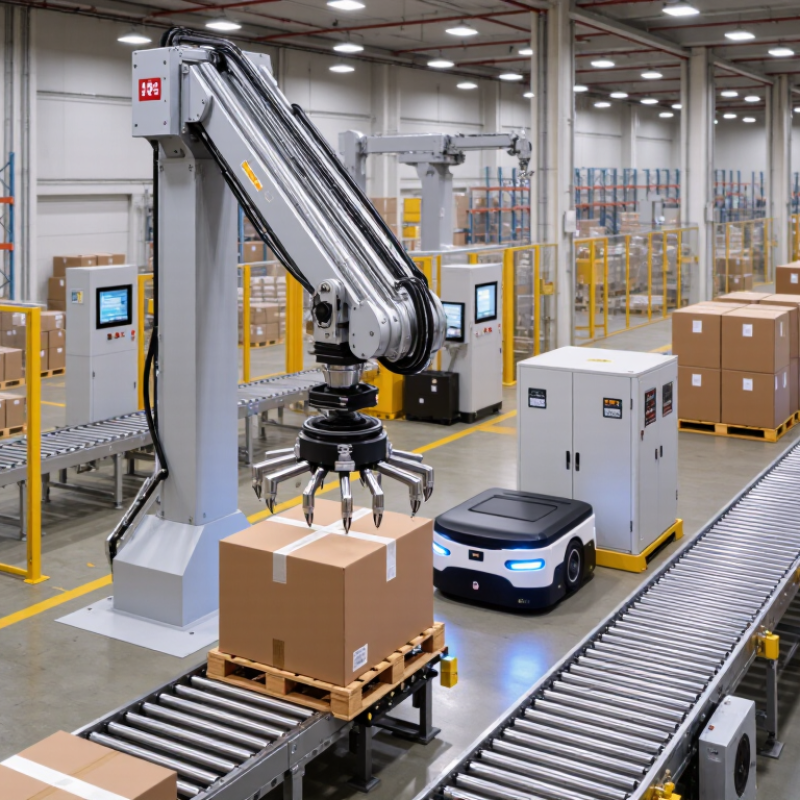
Palletizing Machine technology is reshaping factory logistics, especially where cartons, bags, and cases move continuously. In 2023, manufacturers installed 541,302 industrial robots worldwide, according to the International Federation of Robotics’ World Robotics 2024 report. That figure shows strong automation demand, although the market still faces investment pressure and uneven regional growth.
China has become an important sourcing base for palletizing equipment. Its manufacturers offer robotic, conventional, high-level, and collaborative palletizing solutions. Buyers should examine payload capacity, cycle speed, gripper design, footprint, software compatibility, and after-sales service. A machine handling 25-kilogram bags needs different engineering from one stacking fragile food cartons. Small details matter. Dust protection matters too.
The PMMI report on automation trends in packaging identifies labor shortages, productivity, and operational consistency as major adoption drivers. These factors explain why a modern Palletizing Machine is no longer judged by speed alone. It must protect products, reduce repetitive lifting, and connect reliably with conveyors and warehouse systems.
Marina Bill, President of the International Federation of Robotics, stated, “Robots are essential for remaining competitive in the global market.” Her point applies clearly to end-of-line packaging. Yet automation is not a magic answer. Poor layout planning, weak integration, or limited technician training can reduce expected returns. Some supplier claims also deserve closer checking.
This guide compares China’s leading palletizing machine manufacturers and suppliers through practical criteria, verified capabilities, and service considerations. It also recognizes an uncomfortable truth: the cheapest machine may become the most expensive choice after installation.
A palletizing machine automatically places cartons, bags, trays, or cases onto a pallet. It follows a programmed pattern for stable stacking and efficient handling. Common systems include robotic palletizers and conventional layer palletizers.
A robotic unit uses a gripper, conveyor, sensors, and control software. The conveyor presents each case at a defined position. The robot lifts it, rotates it, and places it on the pallet. Layer by layer, the load becomes ready for wrapping or transport.
The International Federation of Robotics reported 541,302 industrial robots installed worldwide in 2023. This figure shows how widely automated handling is being adopted.
However, palletizing performance depends on more than robot speed. Box dimensions, product weight, pallet quality, and floor space all matter. A fast machine can still create unstable loads.
That is the part many simple brochures miss. In real facilities, dust, crushed cartons, and inconsistent spacing often require adjustment. Operators should test the complete packaging line before selecting equipment.
Tips:
Check the heaviest and weakest cases first.
Confirm the gripper can handle slippery surfaces.
Measure pallet height and aisle width carefully.
Ask for cycle-time tests using real products.
A practical test may reveal problems that specifications overlook.
China Best Palletizing Machine Manufacturers and Suppliers
Main Types of Palletizing Machines Used in China
Palletizing machines in China generally fall into four practical categories. Robotic palletizers use articulated arms, vacuum grippers, or clamp tools to arrange cartons, bags, and cases. They suit mixed products because software can change the stacking pattern quickly. Gantry palletizers move on overhead axes and offer stable positioning for heavy cartons. Their wide frames need careful floor planning.
Conventional high-level palletizers handle large, continuous production lines. They use conveyors, layer-forming stations, and mechanical pushers to build even stacks. Low-level palletizers work closer to the floor and often fit smaller factories or limited-height workshops. Collaborative palletizing cells can support flexible operations, but their speed and payload may not match dedicated equipment. That difference is easy to overlook.
Tips: Check product weight, package surface, pallet size, and required output before choosing a machine. Ask for a real sample test, not only a catalog video. Measure the space around the pallet, too. A layout can look efficient on paper but become awkward during maintenance. In my experience, unstable bags often need better gripping tools and slower acceleration. Even good equipment may need adjustment after installation. Build that learning period into the production plan.
Typical nominal throughput benchmarks for common palletizing machine categories
Layer palletizers generally provide the highest throughput for standardized cartons, bags, and cases. Robotic and gantry palletizers offer greater flexibility for mixed formats, while cobot palletizers are usually selected for lower-volume operations and easier deployment. Values show representative midpoint throughput from commonly specified operating ranges, not market share or company performance.
Chinese palletizing equipment has advanced beyond simple pick-and-place systems. In working warehouses, servo-driven arms build stable layers at high speed. Vision sensors check carton position, label direction, and damaged edges. This detail matters. A misplaced case can weaken an entire load. PLC controls coordinate robots, conveyors, elevators, and pallet dispensers with millisecond timing. Many Chinese manufacturers now configure machines around product weight, dimensions, and available floor space.
Layer-forming technology is especially important for mixed or flexible packaging. Adjustable guides square each row before transfer. Vacuum grippers suit smooth cartons, while clamp tools handle heavier or irregular cases. Automatic recipe changes reduce manual adjustments between production runs. Safety scanners, interlocked doors, and emergency circuits support safer operation. Remote monitoring can reveal motor temperature, cycle counts, and recurring stoppages.
Use real cartons. During commissioning, operators should test actual products, not only sample boxes. Dust, humidity, weak tape, and uneven pallets expose hidden problems. A line may meet its speed target yet create unstable loads. That is an engineering failure worth correcting. Reliable suppliers document acceptance tests, spare-part lists, training, and response times. They also explain limits honestly. No machine fits every factory. Engineers should review washdown needs, communication protocols, pallet patterns, and future capacity before approving specifications. Small omissions can become expensive changes.
Choosing a China palletizing machine manufacturer requires more than comparing prices. Start with your product, packaging size, pallet pattern, required speed, and available floor space. A reliable supplier should explain these details clearly. They should also provide drawings, cycle-time data, and a realistic equipment quotation.
Visit the factory or request a live video inspection. Look at welding quality, cable routing, safety guarding, and the control cabinet. Ask whether the machine has completed similar projects. Customer references matter, but they should be verifiable. Request a factory acceptance test using your actual cartons or bags. Small differences in package weight can affect stacking stability. A polished showroom can still hide weak testing procedures.
Tips: Check service response times, spare-parts availability, warranty terms, and installation support. Confirm the controller, sensors, grippers, and safety components before signing. Ask for training documents in clear English. Avoid selecting the lowest offer without checking its exclusions. Cheap equipment may become expensive when commissioning takes weeks. This part is often underestimated. Also, do not accept vague promises about speed. Put measurable performance requirements into the contract, including acceptable error rates and restart time. A dependable manufacturer welcomes technical questions and admits limitations. That honesty is useful. One practical mistake is focusing only on the robot, while conveyors, pallet dispensers, and software often determine the complete line’s reliability.
| Evaluation Dimension | Typical Industry Benchmark | Recommended Requirement for Buyer | Documents or Evidence to Request | Suggested Evaluation Weight |
|---|---|---|---|---|
| Palletizing Technology | Robotic, conventional layer, gantry, or collaborative palletizing systems are commonly used for different production requirements. | Select the technology according to product shape, required speed, available floor space, changeover frequency, and budget. | Technical proposal, system layout, application references, and product-handling description. | 10% |
| Product Throughput | Approximately 10–40 cases per minute for many robotic applications; higher rates may require layer palletizing. | The proposed machine should achieve the required output continuously, with at least 10%–15% capacity reserve. | Factory acceptance test plan, cycle-time calculation, and performance guarantee. | 15% |
| Payload Capacity | Robotic palletizers commonly handle payloads from approximately 20 kg to 250 kg, depending on the robot model and tooling. | Choose a payload rating that exceeds the product weight plus gripper weight and safety margin. | Robot load chart, end-of-arm-tooling specification, and maximum product-weight confirmation. | 10% |
| Product Compatibility | Typical applications include cartons, bags, trays, cases, pails, drums, and shrink-wrapped packages. | The supplier should test the actual product, including unstable, dusty, flexible, or irregular packages. | Sample test report, product drawings, package dimensions, and handling videos. | 10% |
| Pallet Size Compatibility | Common pallet footprints include approximately 1,000 × 1,200 mm and 1,100 × 1,200 mm, with regional variations. | The system should support all pallet sizes required at the facility and allow controlled pallet positioning. | Approved pallet drawings, pallet magazine specifications, and pallet-positioning details. | 7% |
| Stacking Pattern Flexibility | Modern systems can usually store multiple pallet patterns and layer configurations through the control interface. | Verify support for interlocking patterns, column stacking, mixed-case layers, and recipe-based changeover. | Pattern examples, software screenshots, and the number of stored recipes. | 8% |
| Changeover Time | Automatic recipe changeover can reduce product or pallet-format changes to several minutes, depending on system complexity. | Prioritize tool-free adjustments, automatic parameter selection, and clear changeover instructions. | Changeover procedure, recorded demonstration, and changeover-time commitment. | 6% |
| Machine Footprint | A complete palletizing cell may require approximately 15–60 m², depending on conveyors, safety fencing, pallet dispensers, and wrapping equipment. | Request a layout that includes operator access, maintenance clearance, material flow, and emergency exits. | Dimensioned general arrangement drawing and installation-clearance requirements. | 6% |
| Electrical Requirements | Many industrial systems use three-phase power, commonly 380–415 V at 50 Hz in China and many export markets. | Confirm voltage, frequency, control-panel standards, total connected load, and local electrical compliance. | Electrical schematic, load list, wiring standard, and power-consumption estimate. | 5% |
| Compressed-Air Consumption | Systems using pneumatic grippers or conveyors may require approximately 0.4–0.7 MPa compressed air. | Confirm pressure, air quality, flow rate, filtration, and whether an air dryer or local compressor is required. | Pneumatic diagram, air-consumption calculation, and utility-condition checklist. | 4% |
| Control and Communication | Industrial palletizing cells commonly use PLC-based controls, touchscreen HMIs, safety circuits, and network communication. | Require clear alarm history, password levels, recipe management, remote diagnostics, and integration with line controls. | Control architecture, communication protocol list, HMI demonstration, and software backup policy. | 7% |
| Safety Protection | Typical safeguards include perimeter fencing, interlocked gates, emergency stops, light curtains, scanners, and safety relays. | The safety design should be risk-assessed for the destination country and include safe access for cleaning and maintenance. | Risk assessment, safety-circuit diagram, guarding layout, and conformity documentation. | 8% |
| Build Quality and Reliability | Industrial palletizing equipment should be designed for continuous multi-shift operation with accessible wear components. | Review frame construction, conveyor components, gripper durability, lubrication points, spare-part availability, and maintenance intervals. | Component list, preventive-maintenance schedule, expected service life, and inspection checklist. | 8% |
| Factory Testing | A documented factory acceptance test should verify speed, accuracy, safety functions, product handling, and pallet patterns. | Make payment milestones conditional on successful testing with the buyer’s actual products or representative samples. | FAT protocol, test records, acceptance criteria, and corrective-action procedure. | 6% |
| Installation and Commissioning | Commissioning may include mechanical installation, electrical connection, programming, operator training, and production trials. | Define responsibilities for travel, unloading, utilities, foundation work, installation, training, and production ramp-up. | Installation scope, commissioning schedule, training plan, and site-readiness checklist. | 5% |
| After-Sales Support | Effective support generally includes remote troubleshooting, spare-parts service, technical manuals, and response-time commitments. | Prefer suppliers with written service-level terms and a clear process for software, electrical, and mechanical support. | Service agreement, response-time table, spare-parts list, manuals, and support-contact information. | 8% |
| Export and Compliance Capability | Export projects may require documentation for electrical safety, machinery safety, packaging, customs, and destination-market requirements. | Confirm that the proposed configuration can be adapted to the buyer’s national standards and import requirements. | Declaration documents, compliance checklist, packing list, commercial invoice, and export references without confidential customer data. | 5% |
| Total Cost of Ownership | Purchase price is only one part of the cost; energy, tooling, maintenance, downtime, spare parts, and training also affect lifecycle cost. | Compare the complete delivered cost over at least five years rather than comparing equipment prices alone. | Itemized quotation, energy estimate, consumables list, spare-parts pricing, warranty terms, and maintenance forecast. | 10% |
| Recommended Supplier Selection Method | A weighted scorecard with technical verification and a practical product test provides a more reliable comparison than price alone. | Shortlist three to five qualified suppliers, complete technical clarification, conduct sample testing, and negotiate contractual performance guarantees. | Completed scorecard, comparison matrix, test results, approved drawings, and signed technical agreement. | Overall decision |

Evaluating Chinese palletizing machine suppliers starts with the application, not a polished catalog. Ask for a line layout using your actual carton dimensions, weights, stacking patterns, and hourly target. A serious supplier should explain robot reach, gripper design, conveyor speed, and control logic in measurable terms. Request a video or live test with similar cartons. A staged demonstration may hide unstable transfers. Check cycle-time records, not optimistic estimates.
During a factory assessment, inspect welding quality, cable routing, guarding, and spare-parts labeling. Look for clean panels and accessible maintenance points. Ask who writes the PLC software and how revisions are controlled. The supplier should provide risk assessments, electrical drawings, manuals, and documented factory acceptance tests. Verify safety circuits through practical tests, including gate switches, emergency stops, and restart behavior. Compliance paperwork matters, but actual machine behavior matters more.
Reliability also depends on service after shipment. Confirm response times, remote-diagnostic methods, training hours, warranty boundaries, and local technician coverage. Ask for references from users with comparable production pressure. Call them directly and ask about downtime during the first six months. Be careful with unusually low quotations; omitted conveyors, tooling, installation, or integration can appear later. I have seen projects judged too heavily on purchase price. That mistake is expensive. A supplier may answer every question well, yet vague software ownership or weak spare-parts planning deserves a pause. Leave acceptance criteria in the contract, with test samples, output rates, rejection limits, and payment linked to verified performance.