
China Top 10 Water Chiller Unit Manufacturers
Choosing a reliable water chiller unit manufacturer in China requires more than comparing catalog prices. Buyers must examine cooling capacity, compressor quality, energy performance, control systems, and after-sales support. These details influence production stability, maintenance costs, and equipment lifespan.
This guide introduces ten leading Chinese manufacturers serving industrial, commercial, medical, food-processing, and data-center applications. The selection considers manufacturing experience, engineering capability, product range, certifications, export performance, and customer support. Factory scale alone does not prove reliability. A capable supplier should provide clear technical data, documented testing procedures, installation guidance, and responsive service.
Real-world performance often appears in small details. Check cabinet materials, condenser design, temperature-control accuracy, alarm functions, and spare-parts availability. Ask how each company handles voltage differences, ambient temperatures, water quality, and emergency repairs. These questions can reveal more than polished brochures.
No list is perfect. Market rankings change. A manufacturer suitable for a plastic injection line may not fit a laboratory or cold-storage project. Some suppliers also communicate technical information poorly, even when their equipment performs well. Therefore, readers should verify current certifications, project references, warranty terms, and test records before purchasing. This article offers a practical starting point, not a substitute for engineering review. With careful comparison, buyers can identify a dependable partner and select a water chiller unit that delivers stable cooling, manageable operating costs, and long-term value.
What Are Water Chiller Units and How Do They Work?
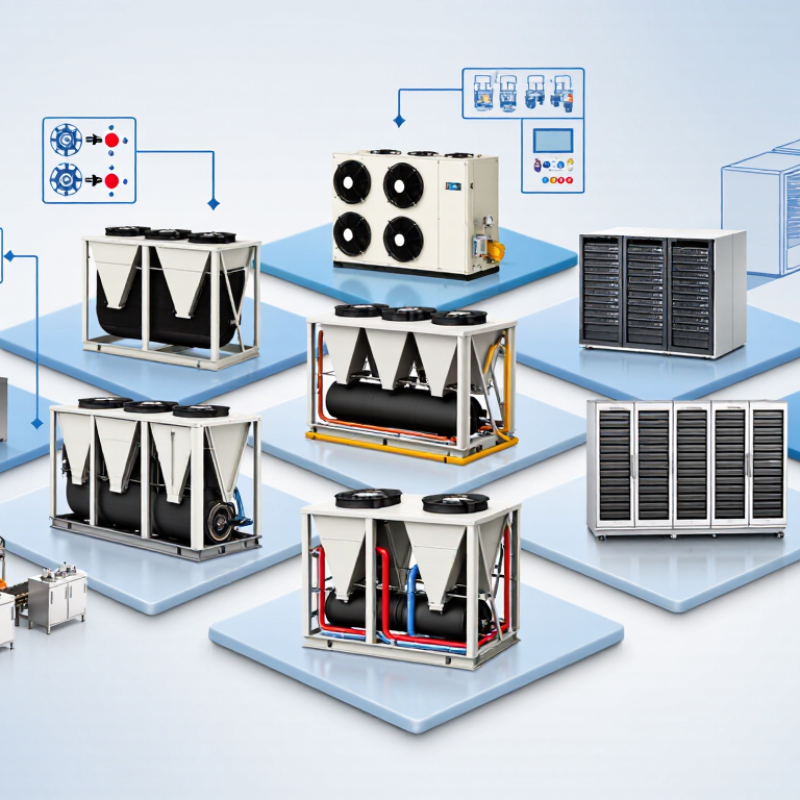
A water chiller unit removes heat from water and transfers it elsewhere. The cooled water then circulates through air-handling coils, fan-coil units, or process equipment. In a typical vapor-compression cycle, refrigerant absorbs heat inside the evaporator. The compressor raises its pressure and temperature. The condenser rejects heat to air or cooling water. An expansion valve lowers refrigerant pressure before the cycle begins again. Four main stages. Simple on paper.
Real systems are less tidy. Pump flow, fouled tubes, outdoor temperature, and partial loads affect performance. According to the International Energy Agency’s The Future of Cooling report, cooling energy demand could more than triple by 2050. Cooling already represents about 10% of global electricity consumption. This pressure makes efficiency important, but efficiency is not only a compressor issue. Designers should examine chilled-water temperature, condenser-water quality, control settings, and maintenance records. A small sensor error can quietly increase operating costs.
The U.S. Department of Energy recommends evaluating chiller performance through part-load efficiency, not only full-load ratings. That matters because buildings rarely operate at maximum demand all day. A variable-speed compressor may reduce energy use during mild weather. However, savings depend on correct commissioning. I have seen impressive specifications produce ordinary results when filters, pumps, or controls were neglected. Water chillers also differ by application: air-cooled units reject heat through outdoor fans, while water-cooled units use cooling towers and often achieve better efficiency. The choice remains site-specific.
| Water Chiller Unit Configuration | Heat-Rejection Method | Typical Compressor or Generator | Typical Cooling Capacity | Typical Leaving Chilled-Water Temperature | Typical Efficiency Indicator | How It Works | Common Applications |
|---|---|---|---|---|---|---|---|
| Air-Cooled Scroll Chiller | Outdoor air through finned coils | Hermetic scroll compressor | 20–500 kW | Approximately 5–7°C | Typical full-load COP: 2.5–3.5 | Refrigerant absorbs heat from chilled water in the evaporator, then rejects that heat to outdoor air through the condenser coil. | Small and medium commercial buildings, offices, retail spaces, and light industrial facilities |
| Air-Cooled Screw Chiller | Outdoor air through finned coils | Semi-hermetic screw compressor | 300–1,500 kW | Approximately 5–7°C | Typical full-load COP: 2.8–3.6 | Twin-screw rotors compress refrigerant continuously, while fans move ambient air across the condenser coils to remove heat. | Large commercial buildings, factories, warehouses, and process-cooling systems |
| Water-Cooled Screw Chiller | Cooling tower and condenser-water loop | Screw compressor | 300–2,500 kW | Approximately 5–7°C | Typical full-load COP: 4.5–6.0 | The refrigerant rejects heat to condenser water, which transfers the heat to the atmosphere through a cooling tower. | Hospitals, hotels, data centers, commercial complexes, and industrial plants |
| Water-Cooled Centrifugal Chiller | Cooling tower and condenser-water loop | High-speed centrifugal compressor | 700–10,000+ kW | Approximately 5–7°C | Typical full-load COP: 5.0–7.0 | A rotating impeller accelerates refrigerant vapor, and the diffuser converts velocity into pressure before heat is rejected through the condenser-water circuit. | District cooling, airports, universities, large hospitals, and high-rise developments |
| Magnetic-Bearing Centrifugal Chiller | Usually water-cooled with a cooling tower | Oil-free magnetic-bearing centrifugal compressor | 300–3,500 kW | Approximately 5–7°C | Typical full-load COP: 5.5–8.0 | Magnetic bearings support the compressor shaft without conventional oil lubrication, reducing mechanical friction and improving part-load performance. | Energy-efficient commercial buildings, data centers, and facilities with long operating hours |
| Modular Air-Cooled Scroll Chiller | Outdoor air through finned coils | Multiple scroll compressors with staged control | 50–1,000 kW per connected system | Approximately 5–7°C | Typical full-load COP: 2.5–3.5 | Several independent refrigeration modules operate in stages, allowing capacity to increase or decrease as the building load changes. | Phased construction, schools, office buildings, and installations requiring redundancy |
| Heat-Recovery Water Chiller | Air-cooled or water-cooled condenser | Scroll or screw compressor | 100–2,000 kW | Approximately 5–12°C | Cooling and heat-recovery performance depends on load balance | Instead of rejecting all condenser heat, the unit transfers part of it to domestic hot water or a heating-water loop while producing chilled water. | Hotels, hospitals, sports centers, food plants, and buildings with simultaneous heating and cooling demand |
| Absorption Water Chiller | Cooling tower and condenser-water loop | Thermal generator using steam, hot water, or direct gas firing | 350–5,000 kW | Approximately 5–7°C | Typical thermal COP: 0.6–1.2 | A heat source separates and recombines an absorbent and refrigerant, replacing most of the mechanical compression used in electric chillers. | Facilities with waste heat, district energy, cogeneration, steam supply, or limited electrical capacity |
| Glycol Process Water Chiller | Air-cooled or water-cooled condenser | Scroll, screw, or reciprocating compressor | 5–1,500 kW | Approximately -10–10°C, depending on glycol concentration | Efficiency depends on fluid temperature and glycol concentration | The evaporator cools a water-glycol mixture, which remains resistant to freezing when process temperatures are below the normal water-freezing point. | Food processing, plastics manufacturing, laser equipment, breweries, and industrial machinery |
| Free-Cooling or Hybrid Chiller | Outdoor air, cooling tower, or both | Mechanical compressor combined with dry cooler or cooling-tower heat exchanger | 100–3,000 kW | Approximately 5–15°C, depending on outdoor conditions | Very low compressor energy during suitable cool-weather conditions | When outdoor air or condenser water is sufficiently cold, heat is removed directly through a heat exchanger; mechanical refrigeration operates only when additional cooling is required. | Data centers, cold-climate buildings, manufacturing plants, and systems with year-round cooling loads |
Note: Capacity, COP, temperature range, refrigerant selection, and operating limits are typical industry reference ranges rather than guaranteed product specifications. Final selection should be based on project load calculations, local climate, water quality, energy regulations, and required redundancy.
Related Posts
-
10 Best Commercial Water Chiller Brands for Global Buyers
-
How to Choose the Right Water Chiller Unit?
-
Best Commercial Water Chiller Solutions for Your Business Needs?
-
Who Are the Top China Industrial Chiller Manufacturers?
-
China Top Recirculating Water Chiller Manufacturers
-
Why Is My Small Water Chiller Not Cooling?